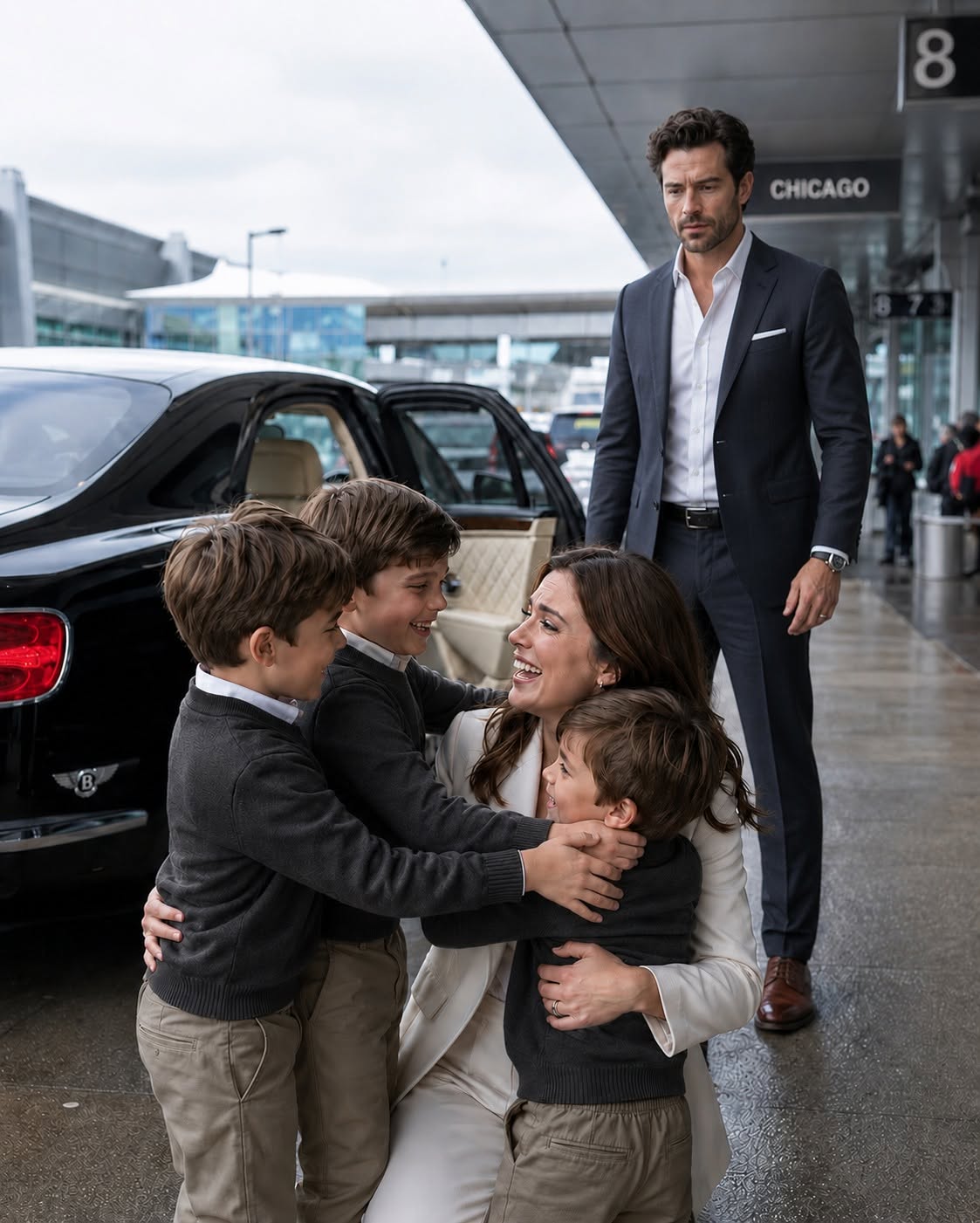
Three months later, Chicago discovered that monsters do not always disappear in handcuffs. Sometimes they turn into witnesses. Sometimes they become fathers in every way except by title. Sometimes, when the world is strange enough, they become free.
David Carter accepted a deal.
No one was shocked by that.
Men like David valued survival far more than dignity.
He handed over Anton’s accounts, offshore records, bribed inspectors, falsified medical files, shell companies, and the names of people who had smiled at charity galas while making money from poisoned tenants.
He wept in court.
The newspapers called it remorse.
Emily called it strategy.
She attended every hearing with Oliver’s drawings tucked inside her purse and her chin held high. When David’s attorney implied she had been manipulated by me, Emily looked at the judge and said, “I was manipulated by my husband for seven years. I recognize the difference now.”
The courtroom fell silent.
Even the judge paused before writing it down.
Claire testified as well.
She lost the Lake Forest house, most of her illusions, and any remaining ability to pretend she had been innocent at the start. But she did something few people manage when truth arrives looking ugly.
She stayed.
She answered every question.
She turned over every document.
And when reporters shouted at her, asking whether she felt guilty, she said, “Yes,” and walked inside anyway.
Nico survived.
He complained every day about physical therapy and told every nurse close enough to hear that he had been heroically shot inside a burning church. That was almost true, though he usually forgot to mention the part where he tripped over a kneeler while reloading.
Oliver visited him once and brought him a crayon-drawn handmade medal.
It said:
BEST BAD GOOD GUY.
Nico framed it.
As for me, the federal government developed a strong interest in my life.
Anton had designed his betrayal carefully. He had connected my name to enough money to make men in suits hungry. But Claire’s files, David’s testimony, and Emily’s recording changed the ground beneath their feet.
I was not innocent.
No honest person could examine my life and claim that.
But I was not guilty of Anton’s crimes.
That difference mattered in court.
Morally, I left that judgment to people with cleaner mirrors.
Six weeks after the fire, I stood among the remains of St. Agnes while contractors measured charred beams. The stained glass had survived only in pieces. One blue shard from Mary’s robe still clung to a window, catching the morning light.
Emily found me there.
She was wearing a green coat now. New. Warm. Buttoned the right way.
Oliver was at school.
A real school, with clean walls, a nurse who understood his care plan, and teachers who did not treat asthma like an inconvenience.
Emily stepped beside me.
“Are you rebuilding it?”
“I don’t know.”
“You should.”
I glanced at her. “You believe in signs now?”
“No.” She looked at the burned altar. “I believe in repairs.”
That sounded exactly like her.
She held out a small box.
“What’s this?”
“Open it.”
Inside was the cracked iPhone.
Her iPhone.
The one she had sold.
The first domino.
I stared at it.
“I thought you needed this.”
“I did. Then Claire bought me a new one.”
“Claire bought you a phone?”
“She said it was restitution. I said it was weird. She said weird was fair.”
I almost smiled.
Emily nodded toward the phone. “I want you to keep it.”
“No.”
“Yes.”
“Emily—”
“That phone is the reason you saw me.”
I looked at the cracked screen, at the faded Best Mom Ever sticker still stuck to the back.
“You don’t owe me anything,” I said.
“I know.”
She moved closer.
“That’s why I’m giving it to you.”
I still did not take it.
Because objects can become anchors.
Because I had spent my life avoiding anything that demanded I remember tenderness.
Emily reached down, took my hand, and placed the phone in my palm.
Her fingers stayed there for a moment.
“Marcus,” she said quietly. “I’m not asking you to become someone else.”
That was fortunate.
I would have failed.
“I’m asking you not to disappear because you think that’s noble.”
I looked at her.
She had become impossible to lie to.
“I don’t know what I am near you,” I admitted.
Her eyes softened.
“Neither do I.”
Wind moved through the broken church.
Somewhere above us, a bird had built a nest in the bones of the roof.
Life, rude and stubborn, making a home inside ruin.
Emily smiled faintly. “Oliver asked if you’re coming to dinner Friday.”
“He did?”
“Yes.”
“What did you say?”
“I said I’d ask.”
“And what do you want me to say?”
Her smile faded into something more truthful.
“I want you to say yes because you want to. Not because you’re protecting us. Not because you’re guilty. Not because you’re lonely and don’t know what to do with it.”
“That’s specific.”
“I’ve learned to be specific.”
I looked down at the phone.
Then back at her.
“Yes.”
Her breath caught, just a little.
“Okay,” she said.
That should have been the ending.
A burned church.
A child saved.
A mother beginning again.
A bad man invited to dinner.
But life does not end where stories prefer it to.
Two months later, on an ordinary Wednesday afternoon, Emily called while I was in a meeting with lawyers about turning St. Agnes into a community clinic for children with respiratory illnesses.
Her voice sounded strange.
“Marcus.”
I stood immediately. “What happened?”
“Nothing bad.”
That phrase had never comforted me.
“I need you to come to Callaway.”
“Why?”
“Just come.”
The Callaway building looked different now.
The mold was gone. The walls had been stripped, treated, and rebuilt. Tenants had been moved elsewhere during repairs and paid through the trust Emily controlled. Rourke had disappeared from property management forever after developing a sudden passion for moving to Arizona.
Emily waited outside with Oliver.
He wore a dinosaur-shaped backpack.
“Mr. Marcus!” he shouted, running toward me.
I caught him carefully.
He had gained weight. Not much, but enough to make his cheeks softer and rounder. His breathing was clear.
That sound had become one of my favorite things in the world.
“What’s going on?” I asked.
Oliver bounced. “Mom found treasure.”
Emily gave him a look. “Not exactly.”
She led me inside to Apartment 2B.
Their old apartment.
During the final repairs, workers had opened the bedroom wall. Behind the drywall, they had discovered a metal box sealed into the studs.
Not David’s.
Too old.
Inside were plastic-wrapped papers, a small stack of photographs, and a letter addressed to me.
My name.
Written in handwriting I recognized from grocery lists and birthday cards.
My mother’s handwriting.
At first, I did not touch it.
Emily stood quietly beside me.
Finally, I opened the letter.
Marcus,
If you are reading this, then either I became braver than I feel, or the world became strange enough to return what was hidden.
I worked in this building before you were born. The owner then was a cruel man, but his wife was kind. When she died, she left money hidden for tenants he had cheated. He found out. I helped hide it before he could steal it back.
I wanted to tell you, but I was afraid. Afraid he would hurt you. Afraid the money would bring worse men to our door.
There is a deed in this box. Not for a palace. Not for riches. For one small piece of land and a fund meant to help mothers with children who cannot breathe clean air.
I hope one day you use it better than the men around us used everything.
Do not become only sharp, my son.
Become shelter too.
Love,
Mama
I read it once.
Then again.
The words blurred in front of me.
Emily’s hand found my arm.
Not to hold me up.
Only to let me know I could lean if I needed to.
Inside the box was a deed to the narrow lot beside St. Agnes and an old trust account, forgotten but still active, quietly growing through decades of interest.
Enough money to create something.
Not an empire.
A beginning.
Oliver peered into the box. “Is it pirate treasure?”
I swallowed.
“Yes,” I said. “The best kind.”
“What kind?”
I looked at Emily.
Then at the letter.
“The kind that saves people.”
One year later, the St. Agnes Breath Center opened its doors.
No marble lobby. No gold plaques.
Just clean rooms, pediatric specialists, free help with medication, legal support for unsafe housing, and a play area where children with inhalers could color dinosaurs while their parents learned they were not alone.
On opening day, Emily gave the speech.
Not me.
She stood at the podium in a blue dress, Oliver seated in the front row, Claire beside him, and Nico hiding behind sunglasses indoors while pretending not to cry.
Emily looked out over the crowd and said, “A year ago, I sold my phone so my son could breathe for one more night. I thought it was the last thing I owned. I was wrong. I still owned my voice. I still owned my love for my child. And I still owned the right to fight back.”
Applause rose around her like weather.
She turned and looked at me.
“And sometimes,” she continued, “help comes from places we do not understand at first. Sometimes shelter is built by people who spent their lives being storms.”
Nico leaned toward me. “That’s you.”
“I noticed.”
“You gonna cry?”
“No.”
“You look emotionally damp.”
“Stop talking.”
He grinned.
After the ceremony, Oliver dragged me into the playroom to inspect a mural painted across the wall.
It showed a city skyline.
A church.
A mother holding a boy’s hand.
And a tall man in a black coat standing slightly apart, with a tiny fox beside him.
“See?” Oliver said proudly. “That’s you.”
“I’m standing far away.”
“Yeah,” he said. “But you’re facing us.”
Children had a talent for making truth sound simple.
Emily came to stand beside me.
“He insisted on that part,” she said.
I looked at the painted man.
Black coat.
Hands at his sides.
Not leaving.
Not fully entering.
Facing them.
“It’s accurate,” I said.
Emily smiled. “Is it?”
I turned toward her.
A year had changed her.
Not softened her.
Opened her.
She had finished the nursing program David had once hidden from her. She now worked part-time at the center, guiding frightened mothers through paperwork, pharmacies, doctors, and fear.
She no longer looked like a woman carrying the world by herself.
She looked like a woman who had set part of it down and dared the rest to move.
“I still have your phone,” I said.
“I know.”
“I keep it in my desk.”
“I know that too.”
“Of course you do.”
Her smile turned softer.
“Marcus.”
“Yes?”
“Oliver asked me something this morning.”
“That sounds dangerous.”
“It was.”
“What?”
She looked toward the mural.
“He asked if bad men can become family.”
My chest tightened.
“What did you say?”
“I said people are not just one thing forever.”
I stared at the painted skyline until the colors began to blur.
“And then?”
“I said family is who keeps showing up.”
Oliver ran across the room toward Claire, who had arrived carrying a box of donated books. Nico intercepted him, turned him upside down, and was scolded by three nurses at once.
Emily laughed.
The sound moved through me like light through stained glass.
I had no clean past to offer her.
No innocence.
No simple future.
But I had presence.
I had choice.
I had my mother’s letter folded in my wallet, Emily’s cracked phone locked in my desk, and a little boy who had once asked whether I was bad to landlords.
“I can show up,” I said.
Emily took my hand.
In public.
In daylight.
Without fear in her fingers.
“I know,” she said.
That was the happy ending no one could have predicted.
Not David falling.
Not Anton losing.
Not money becoming medicine or a burned church becoming a clinic.
The miracle was smaller and stranger.
A woman who had sold the last thing she owned became the owner of her own life.
A child who could not breathe became strong enough to run laughing through the halls of a place built for him.
And a man Chicago feared learned that protection was not the same as possession, and love was not weakness when it made him stay.
That evening, after everyone had gone, I returned to my office at St. Agnes.
The cracked iPhone sat in the top drawer.
I took it out and turned it over.
The faded sticker still read:
Best Mom Ever.
Below it, Oliver had added another sticker.
A crooked gold star.
On it, in messy six-year-old handwriting, were four words:
Best Bad Good Guy.
I laughed.
Alone in a clinic built from ashes, I laughed until my eyes burned.
Then the office door opened.
Emily stood there with Oliver half-asleep against her shoulder.
“Dinner?” she asked.
I looked at them.
The boy breathing softly.
The mother waiting.
The doorway open.
For once, I did not hesitate.
I put the phone in my pocket, switched off the light, and walked toward them.
And behind us, in the quiet heart of the old church, children slept more easily because one desperate mother had refused to break, and one feared man had finally found something worth becoming better for.